The evolutionary history of rodents extends back to 56 million years. This goes on to show that they have been one of the most persistent species to have survived so far. 40% of all mammalian species belong to the class Rodentia. They multiply very fast—6–9 litters a year with 12–14 in each litter.
Rodents are characterized by two continuously growing incisors in the upper and lower jaws which must be kept short by gnawing. Moreover, it is a universal fact that all animals in general and rodents, in particular, are attracted to plastics products, the plasticizers & polymers. The aromatic odors of polymers, the bright colors & the texture of polymer products are all responsible for animals being attracted to plastic goods.
This has resulted in losses in many applications such as:
Wire and cable industry
Rodents gnawing through wires could result in short circuits leading to fire hazards; whereas damage to optical fiber cables could disrupt the transmission of sensitive communication. Rodents often disturb underground train services and metro rail services. They are often responsible for heavy maintenance cost of duct & direct-buried cable networks.
Agriculture
Rodents are responsible for billions of dollars in lost crops each year. Reports of up to 20% of postharvest losses have enormous economic implications in developing countries. In Asia, a loss of 5% of rice production amounts to approximately 30 million tons; enough rice to feed 180 million people for 12 months. Rodents also cause pre-harvest losses by gnawing away at crops as also tubings used in drip irrigation systems and so on.
Gas pipelines and tubings
Sensitive applications such as gas transfer are also disturbed by chewing of rubber gas tubings and pipelines by these rodents. There have been instances of natural gas leaking out and leading to explosions because of chewed up pipes in which they were hauled.
Besides these, rodents also cause damage to aircraft arrestor systems, automobiles, household appliances, landmines, and the list is endless.
So far the most widely employed methods to tackle the rodent problems are the use of toxic rodenticides or traditional so-called ‘non-toxic’ rodent aversives. Toxic rodenticides which are mainly pyrethroids based while being effective come with their own set of liabilities. Firstly and most importantly since they are toxic they are bound to have a lot of side effects mainly:
- There could be accidental ingestion by non-target species—which could have been otherwise useful, pets and so on. This can prove extremely detrimental in agriculture whereupon application of such rodenticides there could be an elimination of useful earthworms, honeybees and so on.
- Having high vapor pressure would mean that they would volatilize easily which would mean that their application in the wire and cable industry would remain limited. Toxic fumes resulting from these being in the vapor form are far more lethal than the rodenticide being in the original state itself.
- Moreover, most rodenticides have a very fast release mechanism which means that they would leach out to the groundwater reserves as also degrade the soil condition.
- Accidental ingestion by human beings can also have unpleasant effects.
While these are the threats posed by commercial rodenticides, the traditional so-called non-toxic rodent aversives are nowhere close to being 100% effective. Moreover, there are limitations to their being employed on a very large scale.
Thus, employing innovative concentrate formulation techniques and focusing on environmental issues and safety norms is the need of the hour. That is where Rodrepel™ comes in.
Hospitals
Hospital is a place expected to be with utmost hygiene. But to combat the rodent menace, the hospitals are fumigated, which is a most dangerous method of pest control. Glue boards are used that can be dangerous if a patient accidentally sticks to it. Rat poisons are used which are potential of killing the rodents and spreading the death diseases.
In a place like hospital, effective and eco-friendly measures are necessary to keep these pests at a bay. And hence Rodrepel™ can be an effective solution here.
Hotel industry
Hotel industry is a zero-tolerance zone for pest infestation! The fumigation can affect young children’s neurological development. Food keeping areas must be kept away from hazardous chemicals used in fumigation and rat poisons.
Rodrepel™ is compatible with all kinds of thermoplastic and thermosetting polymers such as PE, XLPE, PP, PVC, polyesters, epoxies and paints: both water and oil based. Rodrepel™ is available in the form of concentrate based on LDPE as well as EVA polymeric granules. It is also available as:
- Polymer based masterbatches and concentrates
- Dilute Water based solution for fabrics and textiles
- Paint additive Concentrate for all kinds of paint
- Solution in kerosene or any paint miscible solvent
- 50% concentrated Nano granular form
- CFC-free Aerosol Spray Grades for automobiles, medical equipment, hospitals, restaurants, waste management, schools, military applications etc.
- Direct application Lacquers
As Rodrepel™ is effective at very low levels; it does not interfere with the physical or chemical properties of polymers or compounded polymers. It is designed to withstand the extreme heat of polymer processing as also enhanced and uniform dispersion along the length of the polymer matrix. Since our products are used at low loadings, the physical properties of the polymers or the compounding process are not at all affected.
Rodrepel™ has been incorporated as an aerosol spray, used as a coat to protect from woodpeckers & other birds, used on roofs. Rodrepel™ has been very successfully added to Wires & Cables, Plastic screens & sidings, railway doors & windows, seats, wires & cables used in automobiles.
Safe for animals / Poison free
Since Rodrepel™ is designed to keep the animal away effectively and not kill the rodents or any other animal; it doesn’t harm any target or non-target species in any way. We are committed to our environment & we believe that no harm must be caused to animals or to the environment. Cables & pipes often pass through large expanses of untouched forests & outdoors, several native & protected species often come into contact with these cables. Thus, Rodrepel™ is designed to be a completely harmless product.
Safe for humans
It is safe for humans as well. Therefore, any sort of accidental ingestion wouldn’t prove to be fatal or have any detrimental side effects but merely unpleasant.
Environmental applications
Rodrepel™ is completely inert within the polymer matrix apart from executing its primary function of keeping the animal away. Thus, it doesn’t leach out to pollute and as a result wouldn’t contaminate the groundwater, surface water reserves and soil. Moreover, it has a low vapor pressure which means that it doesn’t volatilize easily thus not resulting in vapors mixing with the atmosphere. Also, it is thermally stable at highest polymeric processing temperatures.
Rodrepel™ is a chemosensory irritant type of an animal aversive which functions by driving the animal away from the target object instead of killing or harming the animal. It is completely free of rodenticides, heavy metals or products such as copper or lead naphthenates, lindane, etc. or chemicals found dangerous or harmful to humans or animals.
Some of the widely used rodenticides include organohalogens based pesticides such as Lindane, Bromethalin, etc. and also heavy metal-based compounds such as Copper Naphthenate and Lead Naphthenate, Zinc Phosphide, etc. The use of such rodenticides is a serious environmental concern as they leach out from the polymer to enter the atmosphere and are later deposited by rain. They get carried into surface water as well as ground water. Being fat-soluble such chemicals tend to accumulate through food chains, as is common with organochlorine rodenticides. This can most obviously affect the aquatic biota and contaminate the surface water reserves, ultimately affecting even human life which is dependent on these for food and sustenance.
Rodrepel™ is completely inert within the polymer matrix apart from executing its primary function of keeping the animal away. Thus, it doesn’t leach out to pollute and as a result wouldn’t contaminate the groundwater, surface water reserves and soil.
LD stands for “Lethal Dose”. LD50 is the amount of a material, given all at once, which causes the death of 50% (one half) of a group of test animals. From the graph, it can be depicted that the rodenticides currently used have very low LD50 value showing higher toxicity whereas Rodrepel™ has a very high LD50 value exhibiting its extremely low toxicity. Most countries like Finland, Indonesia, Korea, Netherlands, New Zealand, Saint Lucia, Sweden, Australia, Austria, Cyprus, Norway, and Sri Lanka have either banned or restricted the use of organohalogen based and other such poisonous rodenticides. A long term or chronic exposure of rodenticides would mean adverse effects on kidney, blood pressure and central venous system of humans.
The harmful rodenticide additives volatilize at polymer processing temperatures and release extremely toxic fumes. These toxic fumes are many times more lethal than the original. Not only does this lead to an extensive loss of chemical during processing; but also poses fatal hazards to workers handling such products on the shop floor. A long term or chronic exposure would mean adverse effects on kidney, blood pressure and central venous system of humans. Carcinogenic and mutagenic disorders have also been reported. Moreover, the use of these rodenticides in agriculture has affected non-target species which are otherwise quite beneficial.
Rodrepel™ has a low vapor pressure which means that it doesn’t volatilize easily thus not resulting in vapors mixing with the atmosphere. It is thermally stable at highest polymeric processing temperatures. The graph below shows the LC50 inhalation of various rodenticides available in the market. LC50 value is the toxicity of the surrounding medium that will kill half of the sample population of a specific test-animal in a specified period through respiration. They have very low LC50 value making them more toxic. These toxic fumes are many times more lethal than the original.
Inhalation of copper dust and fumes is reported to lead to nasal congestion as also congestion of the upper digestive and perforation of the nasal septum. Moreover, most of the formulations based on these metals also contain other so-called inert materials which are mostly petroleum based. These petroleum-based constituents contain many acutely toxic, chronically toxic and carcinogenic compounds.
Rodrepel™ is designed to create aversion effectively and not kill the rodents or any other animal; it doesn’t harm any target or non-target species in any way. The graph illustrates the LD50 dermal values of various rodenticides. Chronic exposure to these rodenticides can lead to anemia as also increases the permeability of membranes which can accelerate the uptake of other toxic substances. These rodenticides are also neurotoxic and can affect nerve transmission and damage the central nervous system. Tests submitted to EPA have found that Copper Naphthenate also induces DNA damage.
| Chemicals | Rats | Bees | Birds | Fish | Human Life |
|---|---|---|---|---|---|
| Lindane | 4 | 4 | 4 | 4 | 4 |
| Lead Naphthenate | 3 | — | 2 | 2 | 4 |
| Copper Naphthenate | 3 | 2 | 2 | 5 | 4 |
| Zinc Phosphide | 5 | 5 | 5 | 4 | 5 |
| Coumarin | — | — | — | — | — |
| Warfarin | 5 | 2 | 2 | 3 | 5 |
| Bromadiolone | 6 | 2 | 4 | 5 | 5 |
| Brodifacoum | 6 | — | 6 | 6 | 5 |
| Bromethalin | 5 | — | 5 | 5 | 4 |
| Indandione | — | — | — | — | — |
| Diphacinone | 5 | 5 | 3 | 4 | 5 |
Toxicity scale: (6) Extremely Toxic · (5) Highly toxic · (4) Toxic · (3) Slightly Toxic · (2) Practically Non-toxic · (1) Relatively Harmless
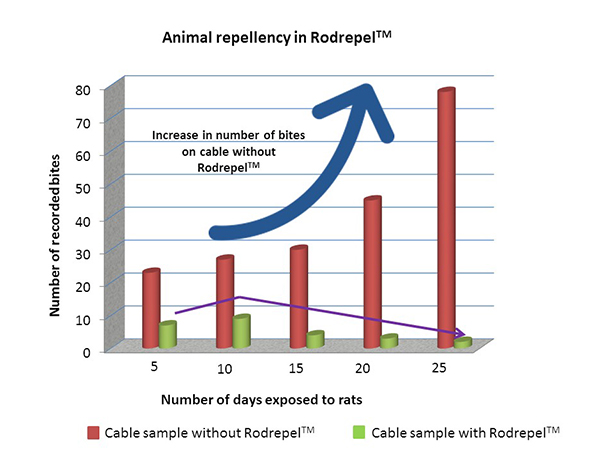
Laboratory tests conducted with cables containing Rodrepel™ have demonstrated that cables bitten by rats produce a very foul reaction in the animal, without harming it in any way. In almost all cases, the animal did not bite the cable again.
These tests were carried across a period of time. The graph in the figure below indicates that the number of rodent bites go on decreasing as days pass with Rodrepel™ extruded cables while an exact opposite trend is observed in cables without Rodrepel™. Moreover, Rodrepel™ has proved to be effective against a wide variety of animals ranging from rats, mice, squirrels, wild boar, to woodpeckers and even to grizzly bears.
Rodrepel™ is available in form of concentrate based on LDPE as well as EVA polymeric granules. Recommended addition level of these concentrates is 1%–5%. It is effective over a very long span of time depending upon the grade (15–40 years).